


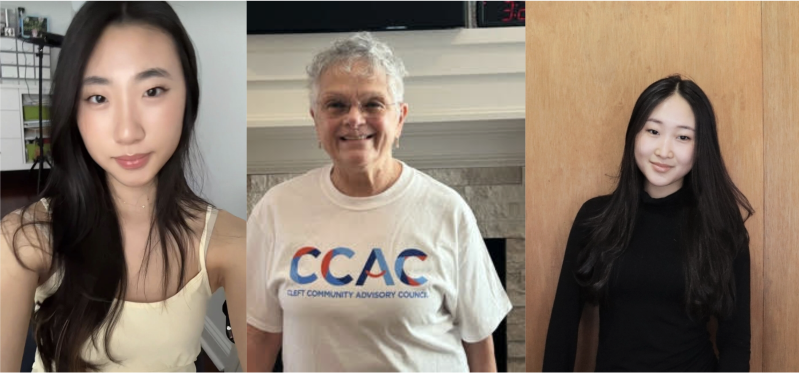
Julia Lee and Noelle Lee interviewing Luci Capo Rome for Cleft Conversations
April 13th, 2026
Hey guys, welcome back to another episode of Cleft Conversations. My name is Julia Lee and I’m the president of Youth for Global Smiles.
Hi, my name is Noelle Lee, and I’m the treasurer for Youth for Global Smiles.
Today we’re joined by Luci Capo Rome. Luci was born with a bilateral cleft lip and palate and grew up in the 1950s and 60s during a time when there was very limited awareness and support for cleft care. In this episode, she shares her early medical journey, the challenges of growing up with a cleft during that era, and how she ultimately became an advocate and support system for others in the community.
Could you start by introducing yourself and sharing a bit about your journey with a bilateral cleft lip and palate?
My name is Luci Capo Rome, and I’m from Olathe, Kansas, a suburb of Kansas City. I was born in a small town in southwestern Pennsylvania. At the time, there was very little awareness or support for cleft care. I spent the first three months of my life in a hospital in Pittsburgh, where I had my lip surgery.
Back then, there was no prenatal testing or special feeding equipment. I was fed with a medicine dropper at first. My birth was a shock to my family, and it brought shame, sadness, and anxiety because no one expected it. It was a very difficult time for them.
How was your experience growing up as a cleft-affected child in the 1950s and 60s compared to what you see today?
Back then, the mindset was to hide things like this. If we didn’t talk about it, it didn’t exist. But of course, that wasn’t realistic.
My family really struggled with it, and I also had a sister who was born 14 months after me with a bilateral cleft lip and palate. She later developed complications and passed away at a young age from respiratory issues. That loss is a very important part of my story.
Growing up, I always felt like I wasn’t good enough or that I wasn’t like everyone else. I absorbed that message early on, which made things very difficult for me.
What were some of the biggest challenges you faced growing up with limited resources and awareness?
One of the biggest challenges was access. My hospital and clinic were about an hour away, but my parents made sure I attended all my appointments.
I had speech therapy from ages 5 to 10, and I was fortunate to have a wonderful speech therapist. I improved a lot and was able to graduate from therapy at age 10.
However, bullying was a major challenge, not just from children, but sometimes even from adults. That still happens today in different forms, but when you’re different, you stand out, and that can be difficult.
Who or what helped you navigate those challenges during childhood and early adulthood?
My grandmother was a huge support for me, along with a few close friends and maternal figures. I often felt a lack of emotional support at home, so I built strong friendships and became close with other families.
I also had great medical support over the years, including surgeons and dentists. But as a young adult, I realized I needed to advocate for myself. At one point, I was told there was nothing more that could be done, but I sought out additional care on my own.
You mentioned starting a support group. Can you tell us about that?
Yes. In 1983, when I was 32, I co-founded a support group for women who were cleft-affected. We met through the University of Pittsburgh maxillofacial clinic.
We would meet in each other’s homes, and it became a deeply healing space for me. It was the first time I felt truly understood and supported by others with similar experiences.
What led to your last surgery at age 51, and how did that feel?
I had a very supportive plastic surgeon who worked on both cleft-related and non-cleft cases. He helped revise my nose and lip, including creating more definition in my cupid’s bow.
One of my most meaningful procedures was my pharyngeal flap surgery in 1988. I had worn an obturator since I was six years old, and when that was finally closed, I was able to stop using it. That moment felt like a turning point in my life.
How has your perspective on cleft care changed over time?
Cleft care has advanced significantly over the years. I continued to seek care as I got older because I knew more was possible.
I had major procedures in adulthood, including jaw surgery in my mid-30s. I feel very grateful for the care I received and the surgeons who supported me throughout my journey.
How did your mindset evolve to the point where you feel comfortable embracing your facial difference?
A big part of that came through therapy, which I attended for about nine years. A lot of my trauma came from how others treated me, not from the surgeries themselves.
Over time, I learned to embrace being different. I started to see it as something unique rather than something negative.
What does confidence and self-acceptance mean to you now?
Confidence comes from everything I’ve accomplished- my education, my career, and my personal growth.
I earned my master’s degree and became both a family nurse practitioner and a psychiatric mental health nurse practitioner. That helped me realize I was capable and worthy of success.
I also stay active through dance, yoga, Pilates, and writing. All of these things have helped me build confidence and healing.
What motivates your advocacy work today?
My advocacy is focused on three areas: supporting young people and families from the beginning, advocating for cleft-affected individuals throughout life, and supporting older adults with cleft conditions.
Cleft care is lifelong, and needs to change as people age. I want to make sure older individuals are not forgotten.
I also attend cleft conferences regularly and see them as a community where everyone supports one another.
What inspired you to write your memoir, Luci's Story: My Imperfect Beauty?
I wanted to share my story and help others understand what it’s like to live with a facial difference.
The butterfly on the cover represents imperfect beauty, which is something I’ve come to embrace.
Writing the book was emotional and difficult, but it was important for me to tell my story honestly.
What advice would you give to young people growing up with a cleft or a facial difference?
Be yourself. Remember who you are and what you are capable of.
Have hope, trust yourself, and listen to your intuition. If opportunities come your way, take them.
Add comment
Comments
Luci:
You are the Very Best. Thanks for being you.
Love;
Dickie