

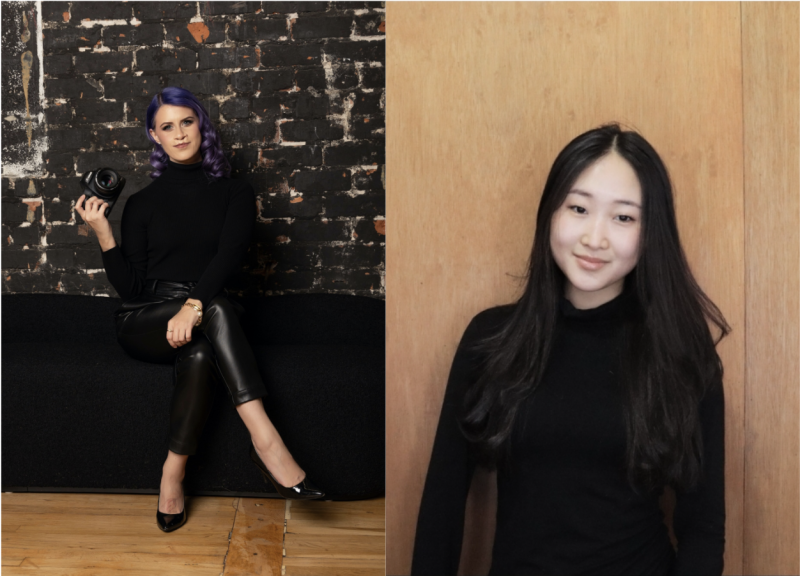
Julia Lee interviewing Miranda Strange for Cleft Conversations
Welcome back to another episode of Cleft Conversations. Today, we're joined by Miranda Strange.
Can you start by introducing yourself and sharing a bit about your journey with cleft lip and how it has shaped your life?
Absolutely, and thank you so much for having me. I'm really happy to be here. I was born with a bilateral cleft lip and palate, as well as Van der Woude syndrome. I grew up in a really small town, so we didn't have a lot of resources. I only knew one other person with a cleft once I was in high school. I kind of went through this all on my own and didn't discover other resources until much later in life. Now that I have found those resources and joined Smile Train for the third year on the CCAC, and this is my first year on the CCSC, it's wonderful to give back, connect with the community, and be the person I wish I had when I was younger.
That's great. I love how Smile Train allows you to join a community of cleft-affected individuals. Even beyond people directly affected by cleft, the whole community is great.
Parents too. All of it. We love it.
What was your experience like growing up with a bilateral cleft lip, especially in terms of confidence and self-image?
It was definitely tough. Like I said, I didn't know anyone with this, and there still isn't a lot of representation in media or anything like that. It was pretty difficult, and I felt very alone. Not having a positive role model in my life made things really challenging. I didn't really begin my confidence journey until I was about 27 or 28 years old, much later in life. I'm glad I have that confidence now, but it was a long road to get there.
Was there a specific moment or turning point when you started to view your cleft experience differently?
Definitely. I feel like there were two parts to it. The first was finding my personal style and being able to express myself in a way that really felt like me. The person inside was finally able to come out and be shown to the world. Clothing, fashion, the way I do my hair, and the way I do my makeup—once I felt like I looked good, I felt good on the inside. That really helped my confidence journey. The second was discovering other people online through YouTube, Instagram, and Facebook who were also cleft-affected and sharing their stories. I thought, "Oh, this is so cool. We exist out there." Seeing other people willing to put themselves out there was really inspiring, and that fueled my next steps.
I feel like social media sometimes gets a negative reputation, but honestly, it allows you to find a community.
That's how we found each other, right?
Exactly.
So it's pretty cool.
How did discovering online support groups and cleft-related communities change your perspective?
I think it was seeing people willing to be seen instead of hiding. I always approached my cleft from the perspective of, "What can I do to distract people from it?" These people were saying, "No, this is what I was born with. This is my journey. This is how I'm helping other people." It completely reframed how I approached my cleft. I was always trying to hide it and put it out of my mind. Then I realized this made much more sense. I can't get rid of it. It's always going to be here, so why am I fighting it? Now I'm able to see that it really is a big part of who I am and where I'm at in life. I definitely learned to embrace it once I saw those stories.
What would you say was the most difficult part of your journey with self-confidence, and how did you work through it?
I think the most difficult part was feeling like I was alone and isolated in my journey. Then I learned there were other people going through the exact same thing. We all have unique journeys and experiences with cleft, but finding that community and realizing I wasn't alone was the biggest shift. Seeing people celebrate their cleft instead of trying to hide it was a huge turning point in how I viewed my own cleft.
You now work in beauty services like hair, makeup, boudoir photography, and pin-up shoots. What inspired you to enter this field?
I've always been a creative person. My background is actually in fashion and costume design, so naturally, it led from one thing to another. I've always loved dressing up. I'm fascinated by beauty, glamour, and fashion. It translated very easily into those areas. It definitely wasn't my first career choice, but things happen in life, opportunities come along, and it just felt right. Now this is what I do, and I can't imagine doing anything else. It's wonderful to make people look and feel good.
How do you think your personal experience influences the way you help clients feel confident and seen today?
I think it's mainly because I've been there. I know what it's like to feel unconfident in how you look and how you show up. By tapping into my personal experiences, I can relate to clients a little more and help them work through whatever they're feeling. That's another positive way I've been able to use my cleft journey.
Boudoir photography and pin-up styling can be very vulnerable experiences for many people. How do you help clients feel comfortable in those moments?
That's a little hard for me to answer because I get told that a lot, that I make people feel comfortable. Pretty much every client I've ever had has mentioned it, which is a great feeling. I guess what I normally do is work. I'm just real with them. I talk to them and match their energy. I'm always encouraging and positive. Sometimes I have to turn my own energy up to 110% just to help bring them up too, and I love that. It's also helped me break out of my own shell because I used to be incredibly shy. Now I love being that extroverted person in my work. Sometimes it's saying silly things or sharing my own experiences. A mixture of all of that seems to do the trick.
I can relate to that a little. I've always been more of an introvert, especially as a child. Through Cleft Conversations and other programs, I've found myself in situations where I'm surrounded by people I don't know and have to socialize. I think that has really helped me get out of my comfort zone and talk to new people.
It's not as scary as it seems once you do it. Everyone is probably feeling some type of way in a room full of strangers.
In your opinion, what role does beauty work play in helping people heal or rebuild confidence after struggles with appearance?
Beauty and fashion really helped me come out of my shell and find a new level of confidence. I'm a big believer in the idea that when you look good, you feel good. I definitely encourage people to put extra effort into their appearance. I don't think it's vain or superficial. We all deserve to look and feel beautiful. Dress the way you want, wear your makeup the way you want, and do your hair the way you want. It all adds up and makes you feel a certain way. I love getting dressed up when I go out with friends. The other day I went somewhere with a friend, got all dressed up, wore a nice outfit, and did my hair.
That's awesome. It's fun, and life's too short. I always encourage people to dress up and wear whatever makes them happy.
As someone involved with CCAC and CCSC, what does your advocacy work look like, and what impact do you hope to have through it?
Right now we're really pushing for ELSA, the Ensuring Lasting Smiles Act. I'm going to be on a meeting next week to help push that effort forward and connect with others who have been working on that initiative. I'm also in the process of connecting with local organizations to promote Smile Train and the work they do. I'm in the Phoenix area, and CleftCon will be here in July, so that's exciting because I'll be able to help locally and be boots on the ground for those efforts. Beyond that, I try to stay active in online groups, encourage people to join them, share my story on social media, and talk about Smile Train whenever I participate in pageants. It still surprises me how many people don't know about Smile Train, the volunteer boards, or CleftCon, so I'm trying to use my voice and platform to spread awareness.
What advice would you give to someone with a cleft who is still struggling to accept themselves or take steps toward their goals because of fear or self-doubt?
You don't have to take big, scary steps. Confidence can seem unattainable, but it usually develops through smaller steps and small wins. For me, getting to a place where I felt good about how I looked helped me feel better on the inside. For someone else, it might be helping other people, joining a support group, or connecting with just one person who understands what they're going through. Keep building toward the things you want to accomplish and where you want to go. Understand that confidence is a constant journey, and give yourself grace and patience along the way.
I feel like there are so many online groups everywhere. On Instagram, you can search up all these communities, and they're all there.
Whether you're my age, a little younger, or a parent of a child with a cleft, there are so many people you can reach out to nowadays. Even if you follow along from the sidelines, it's still nice to know they're there. This community is so welcoming and wonderful, so don't be a stranger.
When I was first introduced to Smile Train, I didn't know about all the community groups. I didn't know about ELSA, CCAC, CCSC, or the Student Ambassador Program. There are a lot of opportunities and ways to get involved.
There really are, and I love to see it. Like I said, I wish I had that when I was younger and growing up. It's wonderful to see that these opportunities are available now, both for future generations and for older individuals who didn't have those resources before.
Conclusion
That wraps up all the questions I had. Do you have anything you'd like to add?
Well, are you going to CleftCon? Will you be there?
I was invited to CleftCon, but I'm attending another summer program that's five weeks long, and the dates overlap.
You still get to be part of it, though. There's also Virtual CleftCon in the fall, which is always a good time.
I love what you've done with your page and the interviews you've already conducted. You're really helping push this forward. Can I ask what inspired you to start doing all of this?
My younger sister, who's in middle school, has a cleft lip and palate. That's how I was introduced to Smile Train and the cleft community. I created this organization during my freshman year. One of my friends runs a mental health organization and has a podcast similar to Cleft Conversations. I was inspired by that and decided to create this series.
I didn't really know where it was going to go or how I was going to find people to interview, but this is my eighth or ninth episode now, and I've really been enjoying it.
See, all it takes is seeing one other person do something and realizing you can do it too.
Exactly.
I'm glad you're taking that initiative, and I'm sure your sister appreciates you being her second voice throughout this journey. That's really wonderful.
Thank you so much. It was really nice meeting you.
You too. Thank you for having me again.
Add comment
Comments